Showing posts with label science. Show all posts

Tuesday, April 16, 2013

Boston and Dr. Tyson

Just a quick post this morning.

Last night, I traveled up to Iowa City to see Dr. Neil deGrasse Tyson with two of my friends. He was fantastic. He brought the humor, the science, the passion that he is known for. It was a wonderful night, especially after a long day at work and learning about the Boston Marathon Attack.

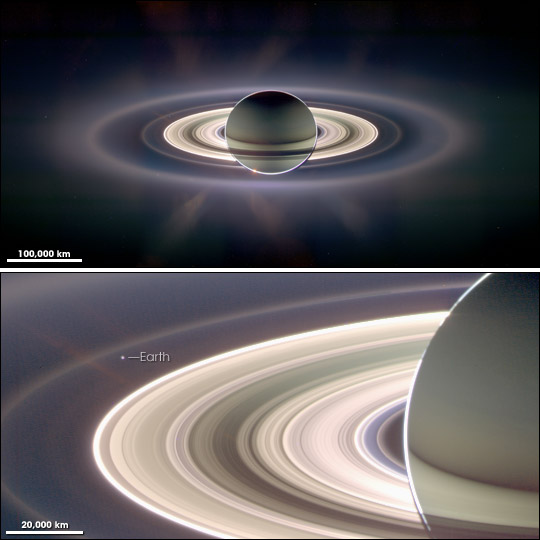
Near the end of his talk, Dr. Tyson reminded us all of something incredibly important that transcends everything he had talked about before. Invoking the spirit of Carl Sagan, he showed the audience a photo (seen below) that the Cassini probe took of a Saturn-solar eclipse. Saturn was sitting in front of the sun, creating an eerie glow around the planet and its rings. But hidden off to the left of the rings was, as Sagan so famously called it, the Pale Blue Dot.

It is Earth.

Dr. Tyson reminded us, as his mentor Carl Sagan did, that on that tiny pale blue dot exists everything you have ever known, including all the rulers, bloodshed, and accomplishments of history. It even includes the tragedy of Boston. When we look at the Pale Blue Dot, we must remember to be humble, to treat each other with kindness, and to remember that we are all a part of a greater universe.

When we teach people that, let us hope that they understand the importance of this life on Earth and make it the best one they can. If we teach this way, we can hopefully snuff out the evil that exists and lingers in our world. And hopefully never have another Boston attack again.

Monday, April 8, 2013

NOVA: Meteor Strike

I had a delightful evening a couple of weeks ago when I happened upon an excellent NOVA program on PBS entitled "Meteor Strike." The program detailed not only the threat to Earth from space-bound rocks but showed examples of previous meteorite strikes. I learned that some meteors are actually made almost entirely out of metal. A British museum showed how one of their meteorites had actually been crafted into a perfect trailer hitch.

The main part of the episode, though, focused on the recent February meteorite strike near Chelyabinsk, Russia. This was the most documented meteorite strike in world history, thanks to so many Russian dashboard cameras. On a side note, Russians are terrible at driving and require huge amounts of expensive insurance, so lots of people carry these cams on their dashes to prove what happened. Who would have ever guessed they would record an historic, scientific event?

The science in the episode is breathtaking. One of my favorite parts involved a scientist who traveled from the U.S. to Chelyabinsk to find the spots from which most of the videos had been taken. Using these measurements, he and his team were able to then pinpoint where the meteorite originated in outer space and what track it came at through the atmosphere. They were also able to determine the size, speed, and trajectory of the object  as well. They even found shards of it in the nearby Chelyabinsk fields. 

Programs like this help us understand nature quite a bit but they also remind us that we need to remember that we are not immortal. If this strike had occurred just a little differently over a larger populated area, there could have been many casualties. We also need to be aware that we are intelligent enough as a species to prevent these kinds of things from harming us in the future. We need to fund the programs that track these objects and build orbital systems to intercept them. It's entirely possible, but we just need the money to do it.

Finally, this video is one of my favorites from the recent Chelyabinsk event.


Tuesday, April 2, 2013

Death from the Skies!

My most recent read was from astronomer Phil Plait, who writes the Bad Astronomy blog over at Slate. "Death from the Skies" chronicles all of the possible ways that our planet, and life as we know it, could be destroyed by non-terrestrial natural events. This is definitely not light reading nor does it always perk you up, but it is funny, highly informative, and humbling. Plait's description of our solar system, galaxy, and universe help you to appreciate our position in the cosmos. But how do we survive? Here's how.

Plait covers a wide range of deadly outer space culprits in an attempt to show you just how powerful nature is. The list includes: gamma ray bursts from black holes, solar flares/coronal mass ejections, asteroid impact, comet impact, galactic collision (that's a slow death), and many others. Each chapter starts with a fun little 2-3 page story of humans observing these things from Earth, and they can be a bit scary. After that, the writing is filled with excellent science writing mixed with Plait's clever humor. You come away from this book with far more knowledge of nature than just what can kill us. Plait does an excellent job of explaining how so many different natural forces work, from gravity to chemistry to geology to quantum mechanics.

Here's the good news: most of these things are not going to kill us. The chances of gamma ray bursts or galactic collisions happening are slim. However, the two chapters that I enjoyed the most are actually the chapters the tell the story of our two most likely killers: solar radiation and asteroid/comet impacts.

Plait makes a great case near the end to increase funding towards protecting our planet against solar radiation and impacts from extra-terrestrial bodies like comets and asteroids. There are some great ideas, scientists, and programs out there that just need more funding to get their plans off the ground. A coronal mass ejection could wipe out our power grid and send us plunging into medieval times. It could even damage our ozone layer, which leads to huge long-term problems. And we all know what an asteroid or comet impact could do. The dinosaurs know all about that. But we can prevent these, the most likely problems, if we just work harder at it.

This was a fun, engaging read that I recommend to folks who enjoy a good science book, especially those of you who enjoy astronomy.


Wednesday, February 27, 2013

Ancient Mars

The evidence just keeps rolling in that Mars once had water. It might still have some, actually, and that's why the Curiosity rover is there now, exploring the Red Planet. Here's my favorite photo of the week, from Mars Express, showing possible evidence of an ancient river or area of flowing water. Pretty exciting, isn't it?


Wednesday, February 13, 2013

Knowing Our Sun

Do you know about the Solar Dynamics Observatory (SDO)? It is one of NASA's greatest achievements because it has allowed us to learn all about our sun. The probe has been up there for about three years now and has been consistently beaming back the most amazing images and video of the sun we have ever seen.

It is scientific instruments like the SDO that allow us to know more about our world. We can gain confidence about future events and be able to explain things to a young child that asks us what that bright thing in the sky is. Put simply, science allows us to satiate our curiosity while at the same time increasing our demand for new knowledge. The SDO gives us a chance to ask better, stronger questions about our world.

Now, enjoy this incredible video put together by NASA. You will be floored by the imagery of our sun.


Wednesday, January 23, 2013

The Future of Science

I love reading about young people getting involved in science and not just because of an assignment or an obligation. They really love it and they show deep passion for it.

One recent example that I came across was a young woman named Deepika Kurup. She's 14 years old and on a trip to India, saw children drinking polluted water right out of a stream. What did she do? Write a letter? Donate money? Start an organization to shed light on this issue?

Nope. She developed a new way to treat water so it's drinkable. Just watch her presentation and wait for your jaw to drop. This young woman is 14 and she's talking like a professional scientist.


We need more programs like this in our country. Children should grow up celebrating science, devouring books about their world, and asking deep questions about how it works. Many children already do this, but let's make it possible so every child gets an opportunity to see how incredible science is.

Friday, January 11, 2013

Comet Ison: A Welcome Sight in 2013

2013 is already off to an exciting start because of the news of Comet Ison visiting Earth's orbit sometime later this ear. Comet Ison was detected by amateur astronomers in 2012 and based on the early observations, it looks like Ison will be quite bright by the time it reaches naked eye visibility from Earth. Right now, Ison is somewhere near Jupiter and won't make it to Earth until late November of 2013. The only problem Ison might run into in the near future is our Sun.

If a comet gets near our sun, often the ice and other frozen matter that comprise the comet start to melt or off-gas into space. If Ison gets too close to our Sun, it could be destroyed or have its path altered by gravity. However, the closer it gets to our Sun, the more breathtaking it could become as a visible object in the sky. Some scientists have even speculated that Ison could end up being brighter than a full moon.

There is an historical connection here as well. In 1680, people on Earth glimpsed a great heavenly object that was almost certainly a comet. It was described by many cultures in historical texts across the globe. It's possible that Comet Ison could well be the Great Comet of 1680. Comets do return from time to time as they behave like they have been in a slingshot around our solar system (think Halley's Comet).

Humans have long had a problem with comets. For most of our history as a species, history records that many civilizations saw comets as signs of impending doom. Comets were sent by the gods as a warning, or in some cases to bring terrible events on Earth. Although sometimes comets were seen as bringers of good news or the birth of a great person. The fact of the matter is that comets scared the heck out people because they messed up the normally predictable sky that humans had mapped for centuries. In other words, people looked up, saw something that wasn't supposed to be there, and then blamed all their woes on it. Correlation, right? That crazy thing is in the sky at the same time there was a plague. They must be related, right?

Modern science helps us see that lines of thought such as this are outdated and incorrect. A comet in the sky has as much to do with natural events on the planet as a raccoon has to the construction of a Ferris wheel. We can learn so much about our solar system and the beginnings of the universe from a comet, as they are leftover chunks of rock and ice from way back when. Plus, they are a reminder that nature can be a gorgeous thing to behold as long as we approach it with curiosity and a desire to learn rather than fear of the unknown. Comets, like so many other things around us, provide us with information that help us understand and process our world.

Comet McNaught, 01.08.07

Thursday, January 10, 2013

Picture of the Week: Curiosity on Mars

Have you been following the Curiosity Rover on Mars? If not, you should!

For picture of the week, I chose this stunning shot of a rock that Curiosity cleaned up. Why do the dusting? NASA wants to get to the bottom layers of the rock with a drill or laser to take samples. If the Martian dust sits on top of the drilled or lased part, then it will contaminate the sample. So Curiosity cleaned up a little before it went to work.


To learn more about Curiosity, visit it here and here. Also, if you're into Twitter, she also has been tweeting fairly frequently with lots of fun images and data.

The information we are receiving from Curiosity will help us to understand the evolution of the solar system and give us plenty of new ways to think about our own planet. Did life ever exist on Mars? If so, why did it die out? Could we lose our atmosphere like Mars did? The great exploration continues.

Wednesday, January 9, 2013

Spillover by David Quammen


It feels good to get the reading year started with a science book. David Quammen has written some excellent science and nature essays in the past and I thought this book, his newest, would be a fun try at his longer work.

It did not disappoint.

The subject of the book is zoonosis, which is the transfer of a disease from animals to humans. Some of our most famous and deadliest diseases are zoonotic. Quammen travels the globe interviewing doctors, scientists, and patients who have either been infected with or worked with countless bacteria, viruses, or parasites. He chronicles malaria, hendra, hanta, ebola, SARS, flu, HIV, and others. It will definitely open your eyes to how susceptible we are to nature's cruelest bugs.

Quammen's writing style can be deep but also contains quick jabs that will spook you like a scene out of a horror film. You'll be reading fascinating pages about different forms of a virus, how it was isolated, the processes used to identify it, etc. and then all of a sudden he tells you a story about someone who got it and how it spread. The hair on the back of your neck stands up as the science gives way to the gruesome reality of these diseases.

The only part of the book I did not care for was a section he included in the HIV chapter. In it, he creates a sort of historical fiction of how the virus may have traveled from southeast Cameroon over a century ago into the Congo. It's pretty good fiction writing but I didn't feel like it meshed at all with the rest of the science writing in the book. It was kind of an outlier section that made you feel like the book was going in the wrong direction.

I learned a ton from this book. It helped dispel certain urban legends and pieces of misinformation about quite a few viruses. The chapter on SARS will keep you riveted and the chapter on HIV will make you proud of the hard-working scientists who traced HIV back over 100 years into Africa's past.

If you're into science and want something that will both pull back the curtain and scare you at the same time, I recommend this heartily.